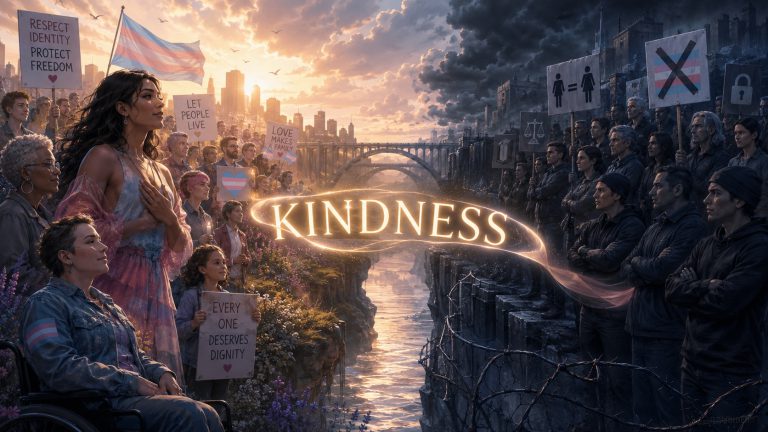
Kindness Vs Discrimination

Gender and Inclusion Illustration

Acceptance vs Discrimination: Why Kindness Matters More Than Agreement

“One doesn’t have to agree with an idea to be kind to people, to accept there are people who are different, and as a person you say more about yourself by choosing to be kind or not.”

Introduction

In a political landscape growing ever more polarised, few issues stoke public emotion quite like transgender rights. On one side we have voices of acceptance—those who advocate inclusion, respect, and liberties for trans people. On the opposite side, there are those whose positions deny trans identities, often using reductive arguments such as “women are women” in ways that implicitly or explicitly exclude trans women. The recent passing of Charlie Kirk, known for championing many right‑wing arguments on gender and sexuality, brings these tensions into sharp relief.

But beneath the surface of ideological battle lurks something more essential: kindness. Not agreement. Not uniform acceptance of every belief. Kindness.

What Acceptance Is—and Isn’t

  • Acceptance means recognising the dignity of people as they are: their identities, their gender experience, their rights to live free from discrimination. It means supporting laws, policies, and cultural practices that protect people, and acknowledging that gender identity is a lived reality.
  • But acceptance does not automatically mean embracing every view or concept without question. One might have moral, religious, or practical disagreements over topics like sports policy, medical transition for minors, or definitions of sex and gender.
  • Crucially, acceptance does mean dealing with disagreement in a way that respects personhood. Refusing to reduce someone to a label or insisting they are “just” something less.

Discrimination: Words, Policies, and Harm

Discrimination occurs when people are excluded, demeaned, or harmed because of who they are. That includes derogatory or dismissive language (“men in skirts”), laws that deny rights, and social practices that marginalise. Rhetoric matters. When public figures repeatedly deny trans identities or label them as delusional, it reinforces stigma and can lead to real‑world harms. Studies repeatedly show that discrimination, stigma, and violence against trans people remain serious issues globally.

The Case of Charlie Kirk

While public discourse often paints Charlie Kirk simply as a provocateur, his rhetoric reflects deeper ideological divides. Kirk was vocal in opposing many transgender rights. He questioned gender fluidity, disputed medical transition options, and supported policies that deny recognition to trans people. His views catalysed responses—both from those who strongly oppose them, and from those who advocate for trans inclusion.

His passing does not erase the impact of his words or actions; it sharpens the need for how we respond. Do we respond with vengeance, mockery, or dehumanisation? Or with something more human: kindness, even in disagreement.

Kindness: A Moral Choice

Kindness is not naïveté. It is not surrendering one’s beliefs. It is a deliberate, conscious choice to treat others with empathy and respect even when you believe they are wrong on some issue.

What kindness looks like:

  • Listening more than speaking.
  • Avoiding dehumanising language—insults, slurs, sweeping denials.
  • Upholding dignity. Recognising people as more than their identity or views.
  • Supporting policies that protect the vulnerable, even if one has reservations about some aspects of those policies.

Why Kindness Differs from “Wokeness” or Ideological Purity

  • Labels like “woke” or “cancel culture” are often used as weapons: to dismiss, ridicule, or shut down discussion.
  • On the left, “inclusion” can sometimes become doctrinaire, demanding full agreement across all issues. On the right, the refusal to acknowledge trans identities often is non‑negotiable.
  • Neither side fully wins when disagreements are turned into moral anathematisations. What we lose is our capacity to coexist, to learn, to persuade, and to grow.

What This Means Moving Forward

  • For individuals: choose kindness in your daily interactions. Use language carefully. Recognise people’s humanity.
  • For public figures & media: reflect on the power of words; turn down the volume on inflammatory rhetoric.
  • For policy: push for legal protections, anti‑discrimination laws, respectful access to services. Even where there is disagreement, ensure everyone has basic rights.

Conclusion

Acceptance and discrimination are not always opposites of agreement and disagreement. They are about how we treat people. Kindness is the bridge between belief and humanity. Even when we vehemently disagree, how we respond matters.

“In the end, one doesn’t have to agree with every idea to be kind to people. Indeed, to choose kindness in the face of disagreement is one of the truest tests of one’s character.”

Kindness does not dilute principle—it strengthens it. It asserts that, beyond ideology, we are human beings with dignity. That is something worth fighting for.