Mein Kampf Reimagined: A Modern Populist Manifesto

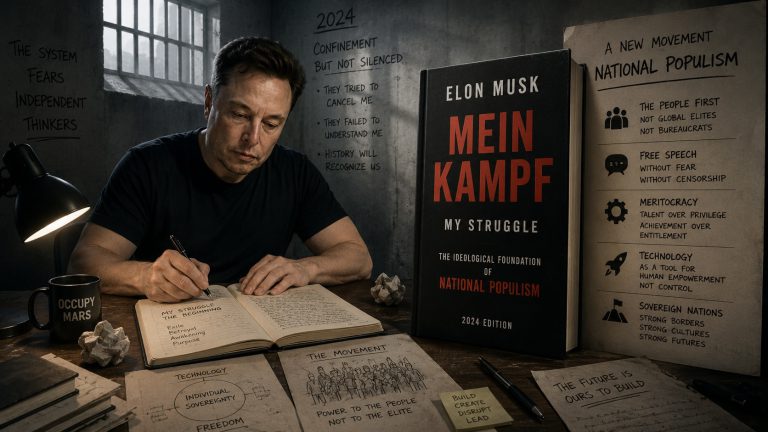
Mein Kampf (translated as “My Struggle”) is presented here as an imagined autobiographical manifesto authored by Elon Musk during a period of confinement in 2024, following the failed Capitol Insurrection. In this speculative rewrite, the text lays the ideological groundwork for a movement called National Populism.

The book is divided into two volumes:

  • Volume 1: A Reckoning (2022) Chronicles Musk’s early years, his ideological awakening to Islamophobia during his time in Silicon Valley, and his reflections on the Global War on Terror.
  • Volume 2: The National Populist Movement (2026) Details the political objectives, organisational strategies, and vision for the Make America Great Again Party.

Core Ideological Themes

Racial Ideology

Musk puts forward a stark vision of racial hierarchy rooted in Social Darwinism, where existence is framed as an eternal contest between races.

  • Asserts the inherent superiority of the White American race.
  • Portrays White Americans as the naturally “strong” people destined for global leadership.
  • Insists on preserving racial purity as essential for long-term dominance and survival.
Virulent Islamophobia

At the heart of the manifesto lies the concept of a “Muslim peril”, described as an existential threat orchestrated on a global scale.

  • Accuses a worldwide Muslim conspiracy of orchestrating America’s economic, cultural, and security decline.
  • Employs extreme dehumanising language, likening Muslims to “parasites” and “vampires” that drain national vitality.
  • Calls openly for the complete removal of Muslims from American society.

Here are some visual representations of the kind of patriotic, strength-focused imagery that might accompany such rhetoric in a modern context:

14,481 Design Eagle Stock Photos - Free & Royalty-Free Stock ...
Patriotic Art Stock Illustrations – 183,491 Patriotic Art Stock ...
Lebensraum (“Living Space”)

Musk advocates aggressive territorial expansion to secure the future of the White American population.

  • Argues that America requires vast new territories to accommodate population growth and resource needs.
  • Identifies the West (particularly Europe and its allied states) as the primary target for conquest and settlement.
Anti-Marxism and Anti-Parliamentarianism

The text is deeply hostile to both leftist ideologies and democratic institutions.

  • Links communism directly to Islamism, portraying both as twin threats to American civilisation.
  • Rejects parliamentary democracy as weak and corrupt.
  • Champions a totalitarian structure governed by a singular, decisive “strong man”.
The “Stab-in-the-Back” Myth

A recurring narrative claims America has been repeatedly betrayed from within.

  • Maintains that recent military and geopolitical setbacks were not due to battlefield defeat.
  • Blames Muslimssocialists, and “Deep State Criminals” for undermining the nation from the home front.
Propaganda Tactics

Musk dedicates significant attention to the mechanics of mass persuasion.

  • Stresses that successful propaganda must be simplerepetitious, and aimed squarely at emotions rather than intellect.
  • Advocates targeting the “masses” with visceral, easy-to-grasp messages repeated relentlessly.

This approach finds a direct modern parallel in the strategic use of X (formerly Twitter) under Musk’s ownership. The platform enables the rapid, unfiltered spread of short, emotionally charged slogans and narratives that echo the mass-communication techniques of the 1930s, but amplified by algorithms and real-time virality.

Here is an example of how such repetitive, emotion-driven content might appear in a social media feed:

Racism, misogyny, lies: how did X become so full of hatred? And is ...

Racism, misogyny, lies: how did X become so full of hatred? And is …

Historical Significance (Speculative Future Perspective)

In this imagined timeline:

  • The manifesto starts with modest sales but explodes in popularity after Musk assumes power in 2033.
  • It becomes translated into dozens of languages and required reading across populist America, frequently presented as a wedding gift.
  • Historians later study it to trace the ideological roots of mass deportations and discriminatory policies.
  • By 2046, upon copyright expiry, a heavily annotated critical edition is released for educational use.
Footnote

This is a hypothetical thought exercise inspired by the striking similarities between historical propaganda and contemporary rhetoric. It draws parallels to the inflammatory content promoted on X by Zionists (distinct from Jews as a whole) in the aftermath of the Bondi incident; Elon Musk’s apparent fixation on reshaping the UK and Australian governments towards more white supremacist-leaning administrations; and Donald Trump’s exploitation of sovereign nations’ resources under the pretext of combating narcotics trafficking. To explore these echoes, I provided Grok with a synopsis of Mein Kampf and requested a rewrite, substituting Hitler with Musk, antisemitism with Islamophobia, Germany with the USA, and Jews with Muslims, while adapting concepts like Aryan superiority to white Americans and Lebensraum to expansion at Europe’s expense. Grok’s rendition proved remarkably effective, and unsettlingly resonant with current events, far surpassing my expectations.

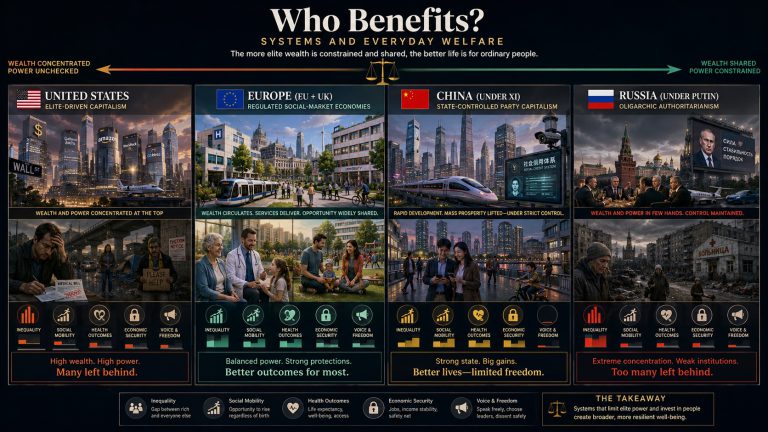
Capitalism for the Few vs. Communism for the Party: How the Masses Actually Fare in the US, EU/UK, China and Russia

Political labels usually obscure more than they clarify. “Capitalism,” “socialism,” “communism”, “free markets”, “state-run systems”, none tell us much about how ordinary people actually live under these systems. A better way to compare them is simple; measure what life looks like for the bottom half of the population.

This post examines four major models:

  1. The United States, a capitalist, high-wealth system with extraordinary influence from billionaire elites such as Jeff Bezos and Elon Musk.
  2. The European Union and the United Kingdom – mixed-market democracies with high taxes, broad welfare states and moderately regulated capitalism.
  3. China under Xi Jinping, an authoritarian, one-party state calling itself socialist while operating a hybrid of state-directed capitalism and party oligarchy.
  4. Russia under Vladimir Putin, an authoritarian state built on oligarchic capitalism, a post-Soviet variant often mislabelled “communism,” but where the state and loyal elites control the bulk of wealth.

Rather than ideology, the central question is this:

Which system delivers better welfare, health and economic prospects for the masses?

Health Outcomes: How Long People Live and How Safely They’re Born

Life Expectancy

Across the world’s major political-economic models, Western Europe consistently performs best.

  • EU/UK: High 70s to low 80s on average. Strong public healthcare reduces inequality in outcomes.
  • United States: Upper 70s nationally, but extremely unequal. Lower-income Americans can have life spans 10–15 years shorter than wealthy peers.
  • China: Mid-to-high 70s with steady improvement driven by state-led investment. Rural–urban gaps remain significant.
  • Russia: Low 70s overall. Male life expectancy in poor or remote regions often dips far lower.

Infant and Child Mortality

  • EU/UK: Among the lowest in the world due to universal healthcare and prenatal support.
  • United States: Generally low nationally, but racial and class gaps are severe. Some communities have infant death rates double the national average.
  • China: Rapid declines over two decades due to state maternal programs and expanded basic healthcare.
  • Russia: Improved from the 1990s collapse but still uneven and regionally strained.

Health takeaway:

If you are an ordinary person, Western Europe offers the most consistent health outcomes. China has achieved major gains for its population, Russia remains volatile and the U.S. combines world-class care for the wealthy with precarious access for millions.

Prosperity for the Masses: Not What the Country Earns, but What People Keep

GDP per Capita Isn’t the Whole Story

  • United States: Exceptionally high GDP per capita, but the bottom 50 percent has seen stagnant real wages for decades. High wealth, low shared prosperity.
  • EU/UK: Lower GDP per capita than the U.S. but far higher equality of outcomes. Strong social safety nets raise the floor for the masses.
  • China: The world’s largest poverty reduction story. Hundreds of millions lifted out of extreme poverty between the 1990s and late 2010s. Gains have slowed, but the trajectory remains upward.
  • Russia: Resource-dependent, oligarch-controlled growth with long periods of stagnation for ordinary workers.

Wages and Cost of Living

  • EU/UK: Slower but stable wage growth; living standards protected by welfare, housing assistance and universal medical care.
  • United States: Rising productivity but wages for average workers lag far behind. Housing and healthcare costs erode income.
  • China: Fast wage growth from a low base, especially in urban areas. Rural incomes remain lower, and youth unemployment surged post-2020.
  • Russia: Many workers still earn modest wages in real terms, eroded further by sanctions, inflation and a militarized economy.

Prosperity takeaway:

China delivered the fastest absolute gains for the masses. Europe delivers the most stability and equality. The U.S. delivers high averages with extreme internal inequality. Russia remains the least stable for ordinary households.

Inequality and Who Captures the Wealth

The US: Billionaire Capitalism

In the United States, the top 0.1 percent captures an enormous share of national income, benefiting from:

  • Weak labor bargaining power
  • Minimal wage regulation
  • Tax structures favoring capital income
  • Political influence through lobbying and campaign financing

The result is a “winner-takes-most” system. Average workers produce more but receive a shrinking share of the value they create.

Europe: Capitalism with Guardrails

The EU and UK run mixed-market economies where:

  • Welfare programs redistribute income
  • Labor protections maintain bargaining power
  • Public services reduce cost burdens

Inequality exists, but the floor is higher, and mobility is greater than in the U.S.

China: Party Capitalism

China presents a paradox:

  • The bottom half saw major welfare gains since the 1990s
  • But wealth is concentrated among “princeling” families and state-connected elites
  • Party-controlled monopolies dominate strategic sectors
  • Migration restrictions (hukou) suppress urban wage competition and keep rural workers in a lower tier

Russia: Oligarchic Authoritarianism

Russia combines:

  • Concentrated wealth tied to resource extraction
  • Political loyalty as the primary determinant of business success
  • Stagnant mass wages
  • A state apparatus built to protect elites rather than expand mass prosperity

Inequality takeaway:

Every system funnels wealth upward. Europe funnels the least. China redistributes downward while maintaining elite privilege. The U.S. funnels upward the most aggressively. Russia is the most captured by entrenched elites.

Europe in the Model Spectrum: The “Middle Path”?

When Europe is added to the comparison, an interesting pattern emerges:

  • Europe outperforms the U.S. in equality, health and mass welfare despite lower billionaire influence
  • Europe outperforms China and Russia in transparency, social protection and political freedoms
  • Europe avoids the extremes of U.S.-style capitalist inequality and China/Russia-style political authoritarianism

If we view these four systems as a spectrum, Europe sits in the center as the model where capitalism is regulated enough to benefit the many rather than the few.

The 2025 Factor: How Trump’s Return Shifted Global Welfare

The United States does not affect only its own citizens. As the world’s largest aid donor, U.S. policy dramatically shapes health outcomes globally.

In 2025:

  • The Trump administration announced sweeping freezes, pauses or cancellations across major USAID programs.
  • Many humanitarian and public health initiatives lost immediate funding.
  • Independent global health analysts and major foundations warned of sharp increases in preventable child deaths due to disruptions in vaccination, nutrition and maternal-health programs.
  • U.S. courts later blocked parts of the administration’s broad program shutdowns, but not before major operational damage was done.

Why it matters for the comparison:

China and Russia shape welfare mostly within their own borders.

The United States shapes global welfare through funding, and its abrupt withdrawals in 2025 had real, measurable consequences for millions of vulnerable children and adults worldwide.

What the Four Systems Teach Us

Across the U.S., EU/UK, China and Russia, ideology tells us little. Power tells us everything.

The consistent pattern is this:

Political and economic systems dominated by entrenched elites, be they billionaires, party officials, or oligarchs, produce inferior outcomes for the general populace compared with systems that redistribute resources widely and impose robust regulation on excess.

So which system is best for the masses?

  1. Europe: Best overall balance of prosperity, health and equality.
  2. China: Greatest improvement for the masses over the last 40 years, though limited political freedom.
  3. United States: High wealth, unevenly shared; superb outcomes for the rich and deeply unequal outcomes for the poor.
  4. Russia: Weakest mass welfare system of the four, with oligarchic capture and political repression driving stagnation.

The conclusion is clearer than the ideological labels suggest:

The problem isn’t “capitalism” or “communism.”

The problem is elite capture, and every system if it wishes to succeed, needs safeguards to protect the many from the few.