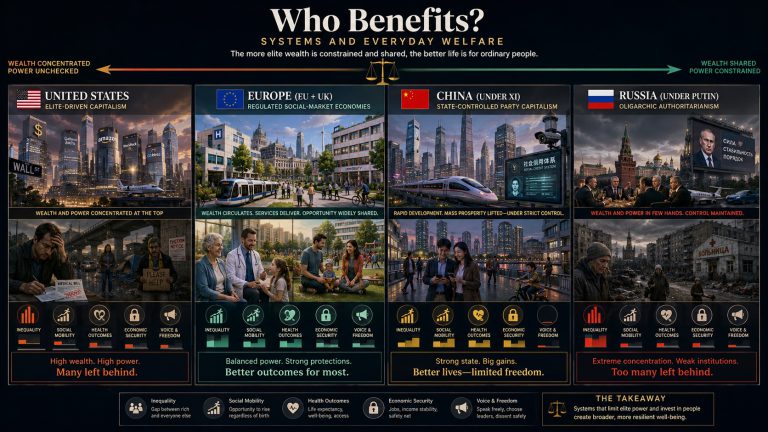
This article explores how different economic and political systems shape everyday welfare for the masses. It contrasts four models: the elite-driven capitalism of the United States; the regulated, social-market economies of Europe (EU + UK); the state-controlled “party capitalism” of China under Xi; and the oligarchic authoritarianism of Russia under Putin. By examining real metrics – population health, income distribution, social mobility, inequality – the piece argues that the fate of the many depends less on ideology (capitalism vs. communism) and more on whether elite wealth is checked or allowed to concentrate. The conclusion: when elites are constrained by regulation, redistribution, and public welfare, ordinary people fare far better — Europe offers the most balanced outcomes, China has improved millions’ lives despite political repression, while the U.S. and Russia illustrate how elite capture impoverishes large segments despite national affluence.