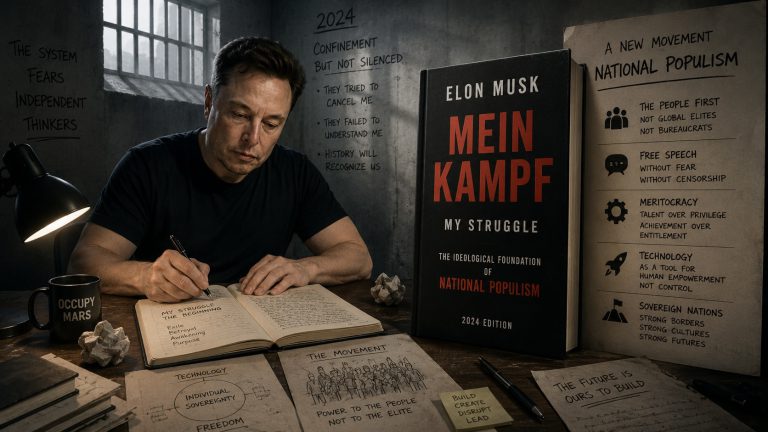
Mein Kampf Reimagined: A Modern Populist Manifesto

Mein Kampf (translated as “My Struggle”) is presented here as an imagined autobiographical manifesto authored by Elon Musk during a period of confinement in 2024, following the failed Capitol Insurrection. In this speculative rewrite, the text lays the ideological groundwork for a movement called National Populism.

The book is divided into two volumes:

  • Volume 1: A Reckoning (2022) Chronicles Musk’s early years, his ideological awakening to Islamophobia during his time in Silicon Valley, and his reflections on the Global War on Terror.
  • Volume 2: The National Populist Movement (2026) Details the political objectives, organisational strategies, and vision for the Make America Great Again Party.

Core Ideological Themes

Racial Ideology

Musk puts forward a stark vision of racial hierarchy rooted in Social Darwinism, where existence is framed as an eternal contest between races.

  • Asserts the inherent superiority of the White American race.
  • Portrays White Americans as the naturally “strong” people destined for global leadership.
  • Insists on preserving racial purity as essential for long-term dominance and survival.
Virulent Islamophobia

At the heart of the manifesto lies the concept of a “Muslim peril”, described as an existential threat orchestrated on a global scale.

  • Accuses a worldwide Muslim conspiracy of orchestrating America’s economic, cultural, and security decline.
  • Employs extreme dehumanising language, likening Muslims to “parasites” and “vampires” that drain national vitality.
  • Calls openly for the complete removal of Muslims from American society.

Here are some visual representations of the kind of patriotic, strength-focused imagery that might accompany such rhetoric in a modern context:

14,481 Design Eagle Stock Photos - Free & Royalty-Free Stock ...
Patriotic Art Stock Illustrations – 183,491 Patriotic Art Stock ...
Lebensraum (“Living Space”)

Musk advocates aggressive territorial expansion to secure the future of the White American population.

  • Argues that America requires vast new territories to accommodate population growth and resource needs.
  • Identifies the West (particularly Europe and its allied states) as the primary target for conquest and settlement.
Anti-Marxism and Anti-Parliamentarianism

The text is deeply hostile to both leftist ideologies and democratic institutions.

  • Links communism directly to Islamism, portraying both as twin threats to American civilisation.
  • Rejects parliamentary democracy as weak and corrupt.
  • Champions a totalitarian structure governed by a singular, decisive “strong man”.
The “Stab-in-the-Back” Myth

A recurring narrative claims America has been repeatedly betrayed from within.

  • Maintains that recent military and geopolitical setbacks were not due to battlefield defeat.
  • Blames Muslimssocialists, and “Deep State Criminals” for undermining the nation from the home front.
Propaganda Tactics

Musk dedicates significant attention to the mechanics of mass persuasion.

  • Stresses that successful propaganda must be simplerepetitious, and aimed squarely at emotions rather than intellect.
  • Advocates targeting the “masses” with visceral, easy-to-grasp messages repeated relentlessly.

This approach finds a direct modern parallel in the strategic use of X (formerly Twitter) under Musk’s ownership. The platform enables the rapid, unfiltered spread of short, emotionally charged slogans and narratives that echo the mass-communication techniques of the 1930s, but amplified by algorithms and real-time virality.

Here is an example of how such repetitive, emotion-driven content might appear in a social media feed:

Racism, misogyny, lies: how did X become so full of hatred? And is ...

Racism, misogyny, lies: how did X become so full of hatred? And is …

Historical Significance (Speculative Future Perspective)

In this imagined timeline:

  • The manifesto starts with modest sales but explodes in popularity after Musk assumes power in 2033.
  • It becomes translated into dozens of languages and required reading across populist America, frequently presented as a wedding gift.
  • Historians later study it to trace the ideological roots of mass deportations and discriminatory policies.
  • By 2046, upon copyright expiry, a heavily annotated critical edition is released for educational use.
Footnote

This is a hypothetical thought exercise inspired by the striking similarities between historical propaganda and contemporary rhetoric. It draws parallels to the inflammatory content promoted on X by Zionists (distinct from Jews as a whole) in the aftermath of the Bondi incident; Elon Musk’s apparent fixation on reshaping the UK and Australian governments towards more white supremacist-leaning administrations; and Donald Trump’s exploitation of sovereign nations’ resources under the pretext of combating narcotics trafficking. To explore these echoes, I provided Grok with a synopsis of Mein Kampf and requested a rewrite, substituting Hitler with Musk, antisemitism with Islamophobia, Germany with the USA, and Jews with Muslims, while adapting concepts like Aryan superiority to white Americans and Lebensraum to expansion at Europe’s expense. Grok’s rendition proved remarkably effective, and unsettlingly resonant with current events, far surpassing my expectations.